DoorDash said it’s only received ‘several hundred’ orders from AI agents

There’s a big uproar about AI agents taking over commerce and orders, but that might not be the case just yet. Delivery company DoorDash revealed during its third-quarter earnings call that it has only seen “several hundred” orders from third-party agents like Muse, Instinct, Fo, and others. For comparison, the company said in its 2025 report it completes an average of 3 million deliveries daily.

“I would say that this [using agents to order] is something that is still a very dynamic area. And my take on all things technology is you never want to fight gravity. But at the same time, you don’t want to be delusional,” DoorDash CEO Tony Xu said in an answer to an analyst’s questions about the topic. “What I mean by that is if you look at where AI agents are today, we’re seeing maybe several hundred orders in total from some of these third-party agents,” he said.

Xu mentioned that users are still predominantly placing orders through DoorDash’s app. However, the company wants to learn more about agentic use cases and develop a healthy relationship with third-party agent makers. He added that, in the future, there could be an opportunity for it to advertise within these agents.

DoorDash has its own agents, including a text-to-order agent it launched in September, a CLI agent introduced in July, and a chatbot called Ask DoorDash it launched in June, which allows users to place orders through prompts and photos. The company also released an MCP to enable ordering from other chatbots for corporate ordering.

The space of agent-based ordering is evolving, as websites are still deciding whether to allow them to access their content or not. Amazon has been blocking such personal agents, but Walmart has laid out a red carpet for them in order to snag some business from its competitors.

more

Olo wants to kill delivery commissions

Olo is launching a new, consumer-facing app for delivery and takeout orders that will offer consumers lower prices than they might find on third-party aggregators, CEO Noah Glass said. 

“Because the delivery marketplaces charge the restaurants a commission, restaurants have offset that by charging a higher price on the marketplaces,” Glass said. These commissions can range as high as 30% on an order, Glass said, and avoiding them is a major opportunity for consumers to save.

While Olo is charging a 5% network fee to consumers, this is significantly smaller than the menu price markups driven by third-party commissions, Glass said. 

“We don’t lump it in with taxes and service fees. We say it at the top of the menu, and we say it at checkout,” Glass said.

The app already includes about 20,000 restaurant locations across 250 brands that use Olo, Glass said, and the tech firm plans to bring it to more of its roughly 90,000 locations, before opening it up to the restaurant industry as a whole.

Glass said the app combines the data advantages of first-party delivery with the consumer discoverability and flexibility of third-party marketplaces.

Who delivers the orders?

The app functions as a sort of second-party ordering platform — something between third-party options like DoorDash and Uber Eats and expensive first-party delivery. 

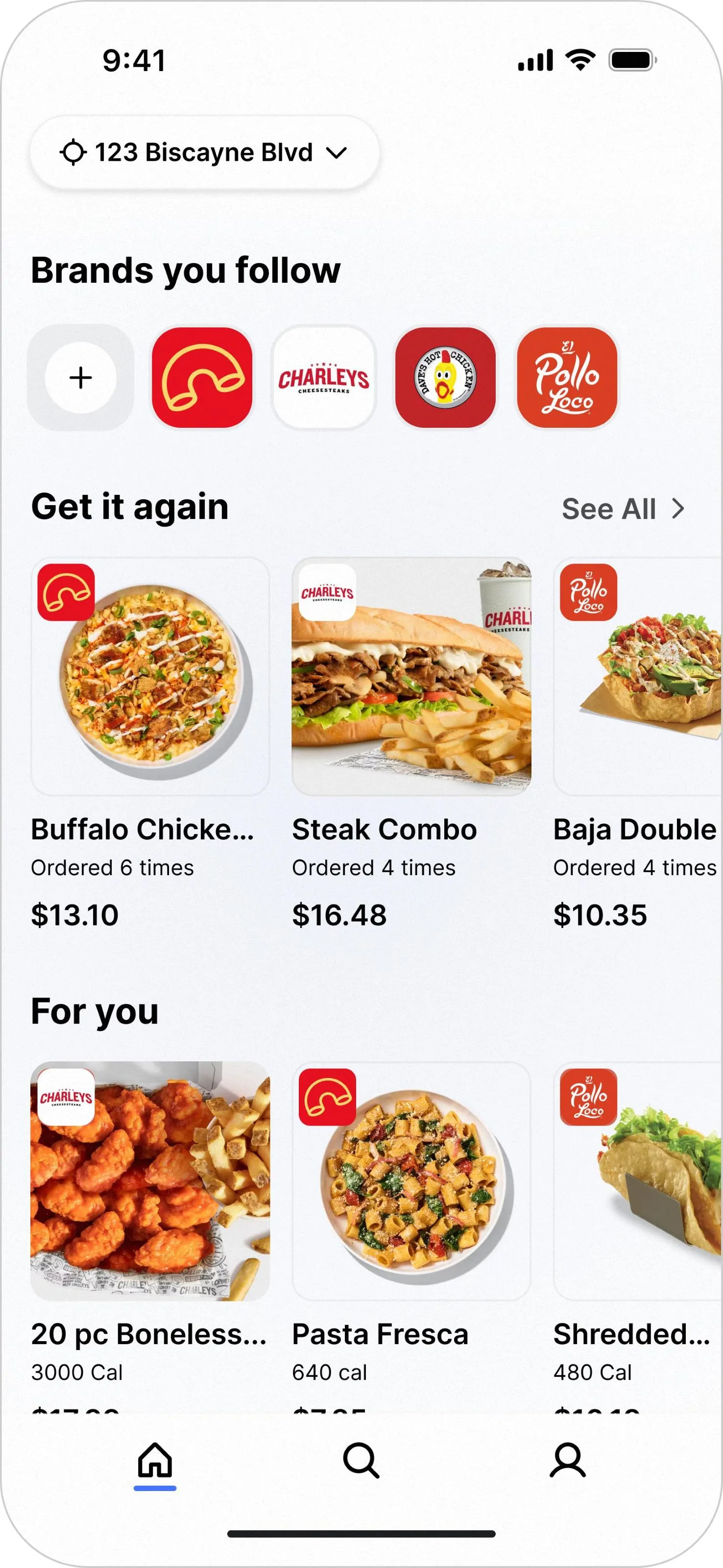
A screenshot of a smartphone with various square buttons for restaurants.
Courtesy of Olo

Olo processes orders through its app the same way it processes orders through partner restaurant’s owned-channels.

“The order, when it arrives, looks exactly to the restaurant as if it came through that first-party ordering platform,” Glass said. This means the operators keep the first-party consumer data and can use it to build a more complete picture of consumer behavior.

Delivery orders placed on the app are sent through Olo’s Dispatch tool, which “will ping all the different delivery services that serve that restaurant, and then we’ll find the best quote for that order,” Glass said. 

Consumers do pay whatever delivery charge the restaurant adds to its orders, while those who might balk at the Olo app’s 5% network fee are free to order through the restaurant’s owned channels. First-party orders remain advantageous to Olo, since they comprise its core business, Glass said.

The orders themselves are fulfilled by drivers, often those affiliated with DoorDash, Uber Eats or other delivery aggregators, though some restaurants have business-to-business delivery services and a few have first-party delivery workers, Glass said. 

While it may seem disadvantageous for the delivery aggregators to accept such orders, the aggregators often have white label delivery deals with restaurants under which they charge a set fee, rather than hefty commissions, Glass said. White label delivery deals, like Uber Direct or DoorDash Drive, and tools like the Olo app, come with an ancillary benefit for the aggregators: A greater volume of orders for drivers.  

That high flow-through of orders coming through a delivery platform keeps drivers loyal to that service, since they have reliable earning opportunities.

A billion orders a year

But Olo has grander ambitions than peeling the commissions off of some restaurant orders and offering somewhat more data to operators.

Glass wants the app to scale up to a billion orders a year by about 2030, roughly equivalent to what Olo’s entire ecosystem of ordering channels currently processes. Olo can achieve this, Glass said, by tapping into a new pocket of demand.

“There are guests who are loyal to marketplaces and will always order through marketplaces. They just like the variety, they like the selection. They like being surprised by new things,” Glass said. 

Another subset of guests are loyal enough to specific brands to consistently order from the brand’s first-party channels, he added.

But Olo is betting that some large portion, perhaps a majority, of consumers, don’t fall neatly into either of those categories.

“There’s this big middle in the normal distribution curve of guests who aren’t quite loyal enough to a brand to download their app, don’t want to pay 15% to 30% more, find delivery really expensive, but do want to have the convenience of food ordering for pickup and delivery with multiple brands,” Glass said. 

Olo’s app is designed to appeal directly to those consumers, offering modest savings, a wide selection and continued convenience.

Glass cautioned that the app was unlikely to cause an immediate shift in industry economics, and it may take a degree of refinement and iteration to hit on a set up that works for a wide base of consumers. But once it does, Olo’s existing user base of roughly 40 million customers could help the tech firm reach significant order volume rapidly.

more

Second-Party Ordering: Lessons from Around the World

On October 20, Olo will launch its own consumer app. As of late September, around 220 brands have signed up, including Dave’s Hot Chicken, El Pollo Loco and Waffle House. Olo has long been part of the technology that powers digital ordering and delivery work for more than 800 U.S. restaurant brands by underpinning the connections between customers, restaurants and couriers.

The Olo App is slated to launch Oct. 20 with a “second-party” model.

Starting as a text-messaging order service, Olo had a customer-facing presence until 2010 when it became a B2B software company. Its newest move, the Olo App, restores it, at least in part, to a customer-facing business.

Restaurants pay no commission on orders placed through the app. They also get access to customer data from across Olo’s network, while actual delivery is handled by third-party couriers. CEO Noah Glass has referred to this as “second-party” ordering—a middle ground between a marketplace and a brand’s own app.

Is the model new? Versions of it have been running for several years in Asia, Europe and Australasia, and among independent restaurants in the U.S. Their experience shows what the approach can do for restaurants, and where the hard work lies: persuading diners to switch. 

What Olo adds is scale, bringing the model to large chains, and it starts with advantages most earlier versions lacked, including its existing brand base and some 40 million diners signed up for its Olo Accounts.

In Malaysia, the point-of-sale system supplier StoreHub launched Beep Delivery within 48 hours of the country’s first Covid lockdown announcement in 2020. It charged restaurant clients an average fee of under 10 percent (against the 35 percent StoreHub claimed marketplaces charged) and later brought its clients together in a shared consumer app.

In 2022, an Indian government-backed network, the Open Network for Digital Commerce, began letting restaurants sell through consumer apps such as Paytm and Magicpin, which typically charge them far lower commissions than the market leaders, Swiggy and Zomato. By its own 2024 count, ONDC handled food orders equal to about 3 percent of the two leaders’ volume. 

Foodhub, which is now headquartered in Dublin, lists software clients at no charge on its consumer marketplace and works with more than 30,000 restaurants across Ireland, the UK, the US, Australia and New Zealand. Meanwhile, in the U.S., Toast already runs Toast Local, its commission-free marketplace for restaurants using its system.

None of these has yet displaced a market leader. Thailand and South Korea show what happens when a bank or a government spends heavily to try.

In October 2020, Thai lender Siam Commercial Bank launched Robinhood Food Delivery, a delivery app charging restaurants no commission. Within a year it had 2.3 million registered users. But it ran its own couriers with little revenue to pay for them, and its current chief executive puts losses at 9 billion baht (about $275 million) by the time operations were suspended in 2024. The bank sold the business that year, and in September the relaunched Robinhood set a commission of 10.5 percent. Olo, which does not employ couriers, avoids that cost.

In South Korea, the spending has come from the government. The country has 12 public delivery apps, run or supported by local governments, which charge restaurants up to 2 percent. One of the best known, Ddangyeoyo, reached 2.14 million weekly users a year ago, helped by government-funded discount coupons. It has since fallen to around 1.1 million while over the same period, Korea’s two largest delivery apps, Baemin and Coupang Eats, increased their combined share of delivery-app users to 88.3 percent, their highest yet.

Elsewhere, in Europe, the commission-free tools, such as FoodAmigos in Germany, Jamezz in the Netherlands and Ireland’s Flipdish, help each restaurant sell through its own website and app. Many of these tools also route marketplace orders into the restaurants’ POS systems, working alongside the marketplaces rather than competing with them.

What can US operators learn from all this? Second-party apps are probably best treated as an extra channel rather than a marketplace replacement. Where they have won large numbers of diners, as in Thailand and Korea, it has been on the back of heavy spending, and gains have proved hard to sustain once the money stopped.

For restaurants, the test is whether such an app brings in customers they would otherwise not reach. If it mainly attracts existing customers who would have ordered through the brand’s own app or website, it moves orders from one channel to another without adding sales and could erode margin if those orders carry extra fees or if regular customers start trying rival brands they see listed alongside the restaurant’s own.

However, artificial intelligence could significantly shift the dynamics. Since July, Square has allowed users of ChatGPT and Claude to find its restaurants and place orders without leaving the conversation, with no marketplace commission. A start-up, Bites, is building a similar commission-free network on ChatGPT through partnerships with POS providers. 

If diners regularly ask their AI assistant what to eat, the hardest problem second-party apps have faced—winning diners and keeping them—may matter far less. What would count instead is who holds accurate, live menus that an AI can order from. Olo, with hundreds of brands already on its platform, is well placed to be that network. Its launch on October 20 will be a major test of the second-party model among US chains, and its results will be worth setting against the experience of Thailand, Korea and India.

more

Grubhub Leans Into First-Party Ordering With Sauce Partnership

Grubhub, a top-three third-party food delivery platform by U.S. market share, is cozying up with first-party channels through a partnership with direct ordering, retention and commission-free delivery platform Sauce. 

The partnership adds Miami-based Sauce as a tech partner powering customer-facing ordering and data tools available to Grubhub merchants, while the platform’s nationwide delivery network connects merchants with couriers to execute deliveries.

Wonder-owned Grubhub expanded the use of its fleet to execute direct orders through Olo Dispatch in January 2025. 

“We’re excited to partner with Sauce to bring together direct ordering technology and delivery capabilities in a seamless experience for restaurants,” Rachel Winkelman, Grubhub’s vice president of enterprise partnerships, said in an October 14 press release. “This partnership reflects our shared commitment to helping restaurants support their business and better serve their customers.”

The collaboration provides eligible restaurants with ownership of customer data and relationships for digital orders through Sauce, which also offers a branded online ordering platform, direct-ordering websites designed for mobile guests, search engine optimization and artificial intelligence-powered customer engagement tools.

“Restaurants deserve online order and delivery technology that grows their business, strengthens connections with their customers and delivers a best-in-class ordering experience,” Li-ran Navon, CEO and co-founder of Sauce, said in a press release. “We’re excited to partner with Grubhub to give restaurant operators a powerful direct ordering solution backed by one of the most trusted delivery networks in the industry. Together, we’re making it easier for restaurants to support direct sales while building lasting customer loyalty.”

Leveraging their fleets to meet first-party demand is a practice held by all three leading U.S. third-party food delivery platforms. Uber Direct from Uber Eats works with Cartwheel, Sauce, Square and Paytronix, among other integration partners. Through DoorDash Drive, DoorDash’s courier network services direct-ordering demand through Toast, Olo, Lunchbox and others.

more

Qatar’s Snoonu buys YC-backed BiteSight to add video food discovery

What’s the deal? Qatari super-app Snoonu has acquired BiteSight, a US social and video commerce startup backed by Y Combinator and SurgePoint Capital. Terms were not disclosed.

What does BiteSight do? Founded in 2023, the startup links short-form food videos with restaurant discovery and ordering. It built its early audience in New York and San Francisco.

The app recorded more than 150,000 downloads and reached No. 2 in the US App Store’s Food & Drink category, ahead of Uber Eats and McDonald‘s. It raised $1.5 million from Y Combinator, SurgePoint Capital, and executives at companies including Airbnb and Starbucks.

What’s the endgame? Snoonu wants to move beyond delivery into a broader commerce platform. BiteSight’s content-led format gives it a tool to differentiate in a crowded Gulf market, where delivery platforms compete heavily for customers and merchants.

Why now? The deal follows a wider consolidation push in the region. In July 2025, Saudi platform Jahez agreed to buy a 76.56% stake in Snoonu for $245 million, giving it a foothold in Qatar while Snoonu kept its own brand.

Founder and chief executive officer Hamad Al Hajri framed the deal as part of a plan to attract talent to Qatar. “We want to help position Qatar as a capital for entrepreneurship, innovation and technology,” he said.

BiteSight’s founders will build from Qatar. Co-founder Bernardo Burboa Quiroga said joining Snoonu lets the team combine “our approach to social food discovery with Snoonu’s technology, reach and regional expertise.”

What could go wrong? The strategic value hinges on whether BiteSight’s video-first format can draw users and merchants at Gulf scale — something its US traction does not guarantee. The available reports do not detail the deal’s immediate impact.

The signal: As social media, entertainment, and shopping converge, content-led discovery is becoming a battleground for delivery apps. Snoonu is betting that inspiration, not just logistics, will win the next round of competition.

more

Snoonu acquires US social commerce startup BiteSight to bring content-driven food discovery to the Gulf

The acquisition brings a Y Combinator-backed platform that reached No. 2 in the US App Store’s Food & Drink category into Snoonu’s expanding technology and commerce ecosystem

DOHA, Qatar – Snoonu, Qatar’s homegrown technology company and leading super-app, today announced the acquisition of BiteSight, a US-based social and video commerce startup backed by Y Combinator and SurgePoint Capital. The acquisition marks a strategic step in Snoonu’s continued expansion of its digital commerce capabilities, bringing content-driven food discovery closer to its integrated marketplace and delivery ecosystem.

Founded in 2023, BiteSight developed a platform that connects short-form food content with the ability to discover restaurants and place orders. Through organic growth, the app recorded more than 150,000 downloads in the United States and reached No. 2 in the US App Store’s Food & Drink category, ranking ahead of established names including Uber Eats and McDonald’s.

BiteSight raised US$1.5 million from Y Combinator, SurgePoint Capital and executives from companies including Airbnb and Starbucks. The startup built its initial audience in New York and San Francisco, attracting a community interested in discovering restaurants through engaging, video-led content.

The acquisition brings together BiteSight’s approach to social food discovery and Snoonu’s established marketplace, technology capabilities and regional presence. It creates an opportunity to explore new ways for consumers to discover food and restaurants through content, while enabling merchants to connect with customers through more engaging digital experiences.

As consumer behaviour increasingly intersects with social media, entertainment and online shopping, content-led discovery is creating new opportunities for digital platforms to connect inspiration with transactions. Through this acquisition, Snoonu aims to further develop its technology ecosystem and explore new models of digital commerce tailored to the Gulf’s evolving consumer landscape.

Hamad Al Hajri, Founder and CEO of Snoonu, said:

“Technology continues to reshape how people discover businesses, make decisions and engage with the brands they love. BiteSight has demonstrated the potential of connecting engaging food content with the ability to act on that discovery. Bringing this capability into Snoonu’s ecosystem is an exciting step in our ambition to build more intuitive, connected digital experiences for customers and merchants across the region.

Beyond technology, we are committed to attracting ambitious young innovators and entrepreneurs to Qatar, creating an environment where they can build, scale and bring their ideas to life. We want to help position Qatar as a capital for entrepreneurship, innovation and technology, connecting global talent with the opportunities our ecosystem has to offer.”

Bernardo Burboa Quiroga, co-founder of BiteSight, said:

“We started BiteSight because food is a shared experience by nature, and we wanted to build a marketplace that reflects how people actually discover their next favourite spot. Joining Snoonu gives us an exciting opportunity to take that vision further, combining our approach to social food discovery with Snoonu’s technology, reach and regional expertise. We’re grateful to be part of this journey and excited to build from Qatar, a market with a growing ambition to shape the future of technology and entrepreneurship.”

Lucious McDaniel IV, co-founder of BiteSight, added:

“We’re grateful to our users in New York and San Francisco, to the more than 100,000 people on our waitlist, and to the investors who backed us from the beginning. We’re equally excited to begin this next chapter with Snoonu and its team. Building from Qatar opens up new opportunities to grow our vision, reach new audiences and contribute to an ecosystem that is increasingly focused on innovation and entrepreneurship.”

The acquisition reinforces Snoonu’s broader ambition to evolve beyond traditional delivery services into a more comprehensive technology and commerce platform. By bringing new discovery capabilities into its ecosystem, Snoonu aims to create additional value for consumers and merchants while exploring opportunities to extend content-driven commerce across its markets.

Financial terms of the acquisition were not disclosed. 

About Snoonu:

Founded in 2019, Snoonu is Qatar’s leading homegrown super app and technology company, building a connected ecosystem of digital services across e-commerce, q- commerce, on-demand delivery, last-mile logistics and B2B solutions. Through technology, innovation and strategic partnerships, Snoonu connects customers, merchants and partners across Qatar, making everyday experiences faster, more convenient and increasingly digital. As a homegrown technology leader, Snoonu plays a growing role in Qatar’s digital transformation and ambitions for a diversified, knowledge-based economy. The company continues to invest in innovation, local talent and technology-enabled solutions that create value for consumers, businesses and communities, while expanding its ecosystem and footprint across the region.

For media inquiries, please contact: walid@snoonu.com

About BiteSight

BiteSight is a social and video commerce startup founded in 2023 that connects food discovery with online ordering. Backed by Y Combinator and SurgePoint Capital, the company developed a platform that helps users discover restaurants through short-form video content. BiteSight gained traction in the United States, recording more than 150,000 downloads and reaching No. 2 in the US App Store’s Food & Drink category.

more

This new food delivery service is trying to take on DoorDash and Uber Eats by offering no menu markups

A new food delivery service is taking aim at menu mark-ups — and some entrenched rivals

Restaurant ordering software company Olo is launching its own customer-focused app, it said on Tuesday. The app puts it in competition with more established delivery companies, such as DoorDash and Uber Eats.

On Olo’s app, customers will see the same prices that restaurants charge in-person patrons, the company said. By contrast, third-party delivery services often charge customers higher menu prices than diners would get at a restaurant.

more

Olo launches restaurant ordering app with promise of lower prices

Online ordering provider Olo on Tuesday launched the Olo App, a customer-facing ordering app that is designed to be more cost-effective for consumers and restaurants.

The free mobile app features more than 250 restaurant brands that use Olo, including Waffle House, Five Guys, Noodles & Company, Charley’s Cheesesteaks, First Watch, Dave’s Hot Chicken, Del Taco, Nekter Juice Bar, Shipley Do-Nuts, and Krystal.

The company is actively adding more and hopes to eventually offer all 800-plus Olo customers, as well as restaurants that don’t use Olo.

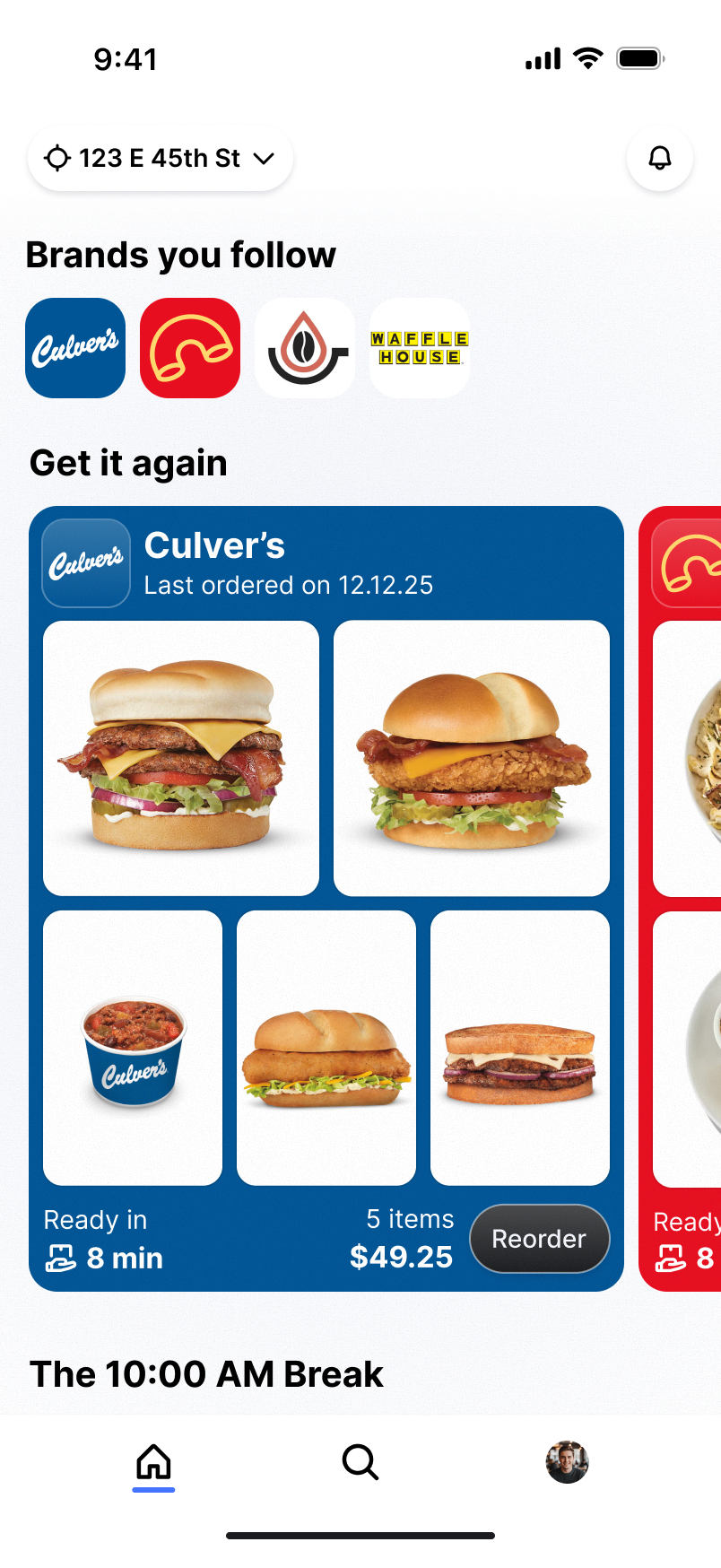
Customers can browse nearby restaurants and create a list of “followed” brands that will show up first when they open the app. They’ll be able to place an order for pickup or delivery, with deliveries handled by third-party providers.

Olo hopes to differentiate the app from third-party delivery apps like DoorDash, Uber Eats, and Grubhub by offering lower prices. Unlike those competing services, which charge restaurants commissions of 15% to 30% on delivery orders, the Olo App is commission-free, so restaurants won’t have to mark up their menu prices to cover those costs.

Customers will still have to pay a delivery fee for delivery orders as well as a 5% network fee, which goes to Olo. They’ll also have the option of rounding up to the nearest dollar to make a donation to No Kid Hungry, a charity focused on ending childhood hunger.

In another difference from third-party apps, restaurants will have access to customer data on orders placed through the app. Customers will be able to control how restaurants use that data for communication and marketing purposes.

Olo is well-known among restaurant operators, but less so among consumers, as it generally works in the background for online orders. That said, more than 100 million unique customers place an order via Olo each year, and about 40 million have created an Olo account that gives them a single login to any Olo-affiliated restaurant.

The company is working to introduce itself to diners with a marketing campaign centered around the message “Never heard of Olo? You’ve already used it.” Marketing materials also tap into consumer frustration with high delivery prices.

Founded in 2005 by Noah Glass as a text-to-order service, Olo later expanded into online ordering, third-party order integration, marketing, and payments. It went public in 2021 and was taken private by tech investor Thoma Bravo last year for $2 billion.

“More than 20 years ago, Olo was born out of a simple idea. What if you could order and pay for a coffee from your phone and have it ready when you arrived?” Glass said in a statement. “The Olo App is the next chapter of that vision, giving consumers a simpler way to discover and order from their favorite restaurant brands in one place while preserving the direct relationships those brands have worked hard to build.”

more

Grubhub moves into dine-in, betting on restaurant traffic and rewards

The new weekly program gives diners Grubhub credit for eating at participating restaurants, including beta debuts in New York City and Chicago with Tacombi, Dos Toros, Chopt and other fast-casual brands.

Grubhub is moving beyond delivery, launching a beta of The Drop, its first dine-in experience, which rewards diners with Grubhub credit when they claim an offer, eat at a participating restaurant and pay with a linked card.

“The Drop extends Grubhub’s role in helping diners discover and enjoy great restaurants beyond delivery and into dining out,” Grubhub CEO Howard Migdal told FastCasual.com.

How it works

Every Thursday, The Drop will give diners up to three personalized offers built around neighborhood favorites, cult classics and “the spots everyone’s talking about.” Diners claim one, dine out and earn Grubhub credit for future orders.

Diners link an eligible payment card, and credit posts automatically after a qualifying purchase. No receipts, promo codes or manual redemption are required.

“It’s designed to become a weekly ritual for diners, with personalized offers refreshed each week,” Migdal said. “Rather than a one-time transaction, it’s meant to become a habit.”

Participating restaurants in the beta include Tacombi, Juice Generation, Chopt Creative Salad Co., DIG, Dos Toros, Momoya, 7th Street Burger and Pokeworks, with more to come.

The initial beta group will receive weekly offers for several weeks before The Drop rolls out to all diners in both markets, which Grubhub plans to do later in October. Additional cities will follow.

“The Drop is designed to be an ongoing program, not a limited-time promotion,” Migdal said. “This phased approach allows us to refine the experience, build momentum, and help diners make The Drop part of their regular routine.”

First product from Claim

The Drop is the first consumer-facing product to emerge from Grubhub’s acquisition of Claim, bringing Claim’s card-linked rewards technology into the Grubhub app.

The company said the program is a significant expansion of its marketplace strategy, connecting dining out with ordering in. By engaging diners whether they are eating out, ordering delivery or shopping for groceries, Grubhub said, The Drop strengthens a “flywheel of discovery, engagement, and repeat usage.”

Pay-for-performance pitch

For restaurants, the pitch centers on limiting risk.

“There’s no upfront cost or platform fees. Restaurants only pay when a diner actually walks in and spends,” Migdal said.

Because the program is card-linked, every visit is verified at the register.

“A restaurant is never billed for budget that didn’t turn into a guest,” he said.

Migdal called The Drop Grubhub’s “first product where restaurant spend is tied directly to someone eating in person.” It sits alongside the company’s other marketing tools.

Asked what percentage of each sale Grubhub takes, Migdal said, “We don’t share the specific commercial details of our restaurant partnerships.”

Restaurants set their own offers, though Grubhub recommends a reward tier for each concept. A coffee shop might offer $5, a fast-casual restaurant $8 and a full-service restaurant $20 or more.

“There isn’t a one-size-fits-all offer,” Migdal said. “The only rule is that it has to feel like a real reward, not a coupon. That’s what gets someone off the couch and in person.”

Not a Groupon

When asked about comparisons to Groupon, Migdal pointed to personalization. Grubhub uses card-linking and customer insights to match offers with diners based on where they already spend and the kinds of restaurants they frequent.

“That means restaurants aren’t simply broadcasting offers to a broad audience,” he said.

Migdal described The Drop for restaurants as “a measurable way to reach highly engaged diners, drive incremental visits and encourage repeat business, with insights into offer performance.”

Any eligible restaurant partner in participating markets can join, Grubhub said. The company said success will mean diners returning regularly to try new places and use their rewards, and restaurants gaining new guests and repeat visits.

What’s next for fast casual? Connect with industry leaders at the Fast Casual Executive Summitin Arlington, Texas, Oct. 4-6, and hear from Clay Dover and Shauna K. Smith of Savory Fund. Bring home fresh ideas and valuable new connections. Reserve your spot.

more

Uber Eats to buy ezCater for $2.3B

The catering platform will expand Uber Eats’ large order business, which has become a significant opportunity in recent quarters.

Dive Brief:

  • Uber Eats has entered into an agreement to acquire ezCater in an all-cash transaction worth $2.3 billion, the companies said in a joint press release.
  • The transaction is expected to close within the next few months. 
  • The deal will combine ezCater’s catering and business-to-business expertise with Uber Eats’ global reach with consumers and restaurants, expanding ezCater’s presence to millions of more customers.

Dive Insight:

EzCater currently partners with over 140,000 restaurants and generated over $2.5 billion in gross bookings over the trailing 12 months, according to the company, and it has grown in the high teens year over year. The business is profitable on a non-GAAP operating income basis and is expected to be “margin accretive,” the press release said. 

By adding catering to Uber Eats, restaurants will have access to a channel to grow large orders and add new diners, per the release. It will also add more options for customers looking into catering for various workplace and social gatherings and create additional opportunities for Uber Eats couriers to gain more revenue. 

The press release didn’t say how ezCater will be integrated into Uber Eats’ platform or if the two entities will remain separate businesses. The companies declined to comment beyond what is in the press release. 

This acquisition is also in line with Uber Eats’ expansion of the occasions it serves through delivery. During the second quarter, the company’s large order and pickup channels, which “present a massive addressable opportunity,” reported strong growth, allowing Uber to expand delivery beyond individual meals, Uber CEO Dara Khosrowshahi, said in an earnings report. 

Catering has become an important growth driver for many restaurants, particularly as it is highly profitable. Average order values for ezCater are over $400. Various chains, including Denny’s, Del Taco, Sweetgreen and Five Guys, have added or expanded catering this year.

Adding catering will also make Uber Eats more competitive against DoorDash, which has also been expanding its business through acquisitions. In September, DoorDash said it would acquire Grubhub’s college campus business for $300 million. Last year, it acquired SevenRooms for over $1 billion and has since added dine-in and reservation management services to its platform.

more